Comparison
Apollo.io vs ZoomInfo: Which B2B Sales Intelligence Platform Is Better?
Deals Stacks
Apollo.io vs ZoomInfo: Which B2B Sales Intelligence Platform Is Better?
Finding the right prospects is one of the most important parts of B2B sales. But sales teams need more than a long list of names and email addresses. They need reliable company information, relevant contacts, efficient prospecting tools, and a practical way to turn data into conversations.
Two platforms that often come up in this space are Apollo.io and ZoomInfo.
Both are designed to help businesses improve B2B prospecting and sales intelligence, but they are not identical.
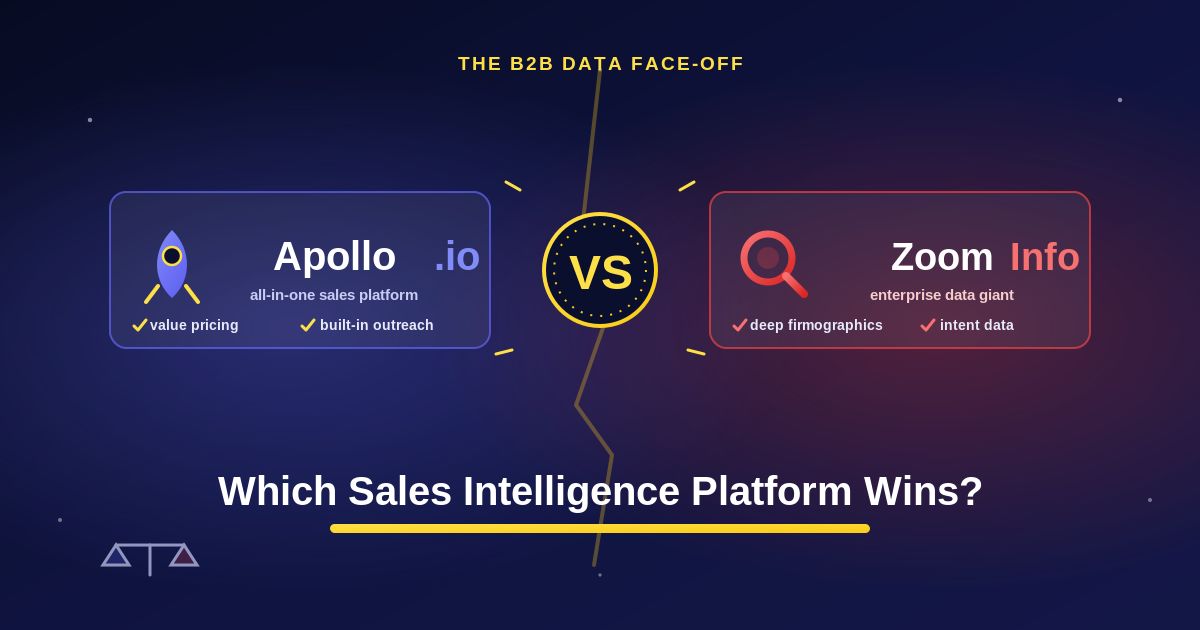
Apollo.io combines a large B2B database with prospecting, enrichment, sales engagement, sequences, automation, and AI-assisted workflows. ZoomInfo provides a broad go-to-market intelligence platform with extensive company and contact data, intent-related capabilities, sales intelligence, enrichment, and other tools for revenue teams.
So, which one should you choose?
The answer depends on your company’s size, sales process, budget, data requirements, and how much functionality you want from a single platform.
This Apollo.io vs ZoomInfo comparison breaks down the major differences to help you make a more informed decision.
Apollo.io vs ZoomInfo at a Glance
Area | Apollo.io | ZoomInfo |
|---|---|---|
Main focus | Sales intelligence + engagement | Go-to-market intelligence and data |
B2B contact/company data | Yes | Yes |
Advanced prospecting | Yes | Yes |
Email sequences | Strong built-in focus | Available within broader sales solutions |
Data enrichment | Yes | Yes |
Intent/signals | Available capabilities | Major part of broader intelligence offering |
Sales automation | Strong focus | Available across GTM workflows |
Best suited for | Startups, SMBs and sales teams wanting integrated prospecting/outreach | Organizations needing extensive GTM data and intelligence |
Pricing approach | Public plan options available | Typically customized based on requirements |
This table provides a simple overview. The best choice becomes clearer when we examine how each platform works.
What Is Apollo.io?
Apollo.io is a B2B sales intelligence and engagement platform.
It helps teams identify potential customers, search for relevant people and companies, access available professional contact information, enrich data, and conduct sales outreach.
One of Apollo’s biggest advantages is that prospecting and engagement are closely connected.
A sales representative can search for potential leads, build a targeted list, and then move prospects into an outreach sequence without necessarily switching between several disconnected platforms.
This makes Apollo particularly attractive to teams that want to simplify their outbound sales technology stack.
What Is ZoomInfo?
ZoomInfo is a go-to-market intelligence platform that provides B2B company, contact, and market intelligence for sales, marketing, and revenue teams.
Its offerings extend beyond basic contact discovery.
Businesses can use ZoomInfo’s data and intelligence capabilities for prospecting, account research, enrichment, buyer signals, territory planning, and other go-to-market activities.
ZoomInfo is often considered by organizations with more extensive data and revenue intelligence requirements.
While Apollo places strong emphasis on combining prospecting with sales engagement, ZoomInfo’s broader positioning focuses heavily on go-to-market data and intelligence.
1. B2B Contact and Company Data
Data is central to both platforms.
Sales teams need to know which companies exist in their target market and who the relevant decision-makers are.
Apollo.io
Apollo provides access to a large B2B database of professional contacts and companies.
Users can search this data using different criteria and build prospect lists based on their ideal customer profile.
The platform connects this data directly with engagement functionality, which can make it easier to move from research to outreach.
ZoomInfo
ZoomInfo is well known for its extensive B2B company and contact intelligence.
Its platform provides detailed business information designed to support sales, marketing, and go-to-market decision-making.
Which is better?
There is no universal winner based only on database size.
The more important questions are:
Does the platform have strong coverage in your target market?
Does it provide the fields your team actually needs?
How accurate is the information for your specific audience?
How easily can your team use and maintain that data?
Testing both platforms with a sample of your real target accounts is often more useful than comparing headline database numbers.
2. Prospect Search and Filtering
A huge database is not useful if you cannot quickly find the right people inside it.
Both Apollo and ZoomInfo provide prospecting and filtering capabilities.
Apollo.io
Apollo allows users to narrow people and companies based on multiple criteria.
For example, a team might search for decision-makers based on job role, company characteristics, industry, location, and other available filters.
This can help turn a broad database into a focused prospect list.
ZoomInfo
ZoomInfo also provides advanced company and contact search capabilities as part of its sales intelligence environment.
Its broader intelligence ecosystem can help organizations research accounts and identify relevant opportunities.
Which is better?
Apollo may appeal to teams that want prospect search closely connected with outreach and sequences.
ZoomInfo may appeal to organizations where deeper go-to-market intelligence and account research are major priorities.
3. Sales Intelligence
Sales intelligence goes beyond knowing someone’s email address.
It is about understanding the business context around a potential customer.
Who is the company?
What does it do?
Who are the relevant decision-makers?
Are there signals that suggest the account may be worth prioritizing?
Both platforms aim to answer these types of questions.
Apollo integrates intelligence into its prospecting and engagement workflow.
ZoomInfo places extensive emphasis on business intelligence, company data, signals, and go-to-market insights.
For organizations with complex account-based sales strategies, the depth of intelligence available may be particularly important.
For teams primarily focused on efficient outbound prospecting and engagement, Apollo’s integrated approach may feel more straightforward.
4. Sales Engagement and Outreach
This is one of the most important areas of differentiation.
Finding a prospect is only useful if your team can turn that information into a meaningful conversation.
Apollo.io
Sales engagement is a major part of Apollo’s platform.
Users can build sequences, organize outreach, automate appropriate steps, and manage different sales activities.
Because prospecting data and engagement exist within the same ecosystem, representatives can move relatively quickly from finding a prospect to contacting them.
ZoomInfo
ZoomInfo also provides sales workflow and engagement-related capabilities within its broader product ecosystem.
However, buyers should evaluate exactly which ZoomInfo products and packages are required for their preferred outreach workflow.
Which is better?
For businesses specifically looking for a tightly integrated prospecting + outreach workflow, Apollo.io can be particularly attractive.
For organizations already investing in a broader ZoomInfo go-to-market ecosystem, ZoomInfo’s connected solutions may fit naturally into their existing process.
5. Email Sequences and Automation
Manual follow-ups become difficult when a sales representative manages hundreds of prospects.
Sequences help create structure.
Apollo has a strong focus on sequences as part of its sales engagement functionality.
Users can create planned outreach workflows and automate appropriate steps.
This can save time, but automation needs to be used carefully.
Sending more emails does not automatically create more opportunities.
Poorly targeted automated outreach simply creates irrelevant messages faster.
ZoomInfo also supports automated sales and go-to-market workflows through its product ecosystem.
The best option depends on how much of your outreach process you want to manage directly within the platform.
6. Data Enrichment
CRM databases become outdated quickly.
People change companies.
Job titles change.
Businesses grow or restructure.
Missing fields make segmentation difficult.
Both Apollo.io and ZoomInfo provide data enrichment capabilities designed to improve existing business records.
Apollo.io
Apollo can enrich contact and company records through supported CRM, CSV, and API workflows.
This can help teams update existing information and fill useful data gaps.
ZoomInfo
ZoomInfo also has a strong focus on data enrichment and data management as part of its broader go-to-market intelligence offering.
Which is better?
Organizations should compare the two platforms using their own CRM data.
Take a representative sample of incomplete or outdated records and evaluate:
How many records can each platform enrich?
Which fields are available?
How accurate are the updates?
How easily does the data sync with your systems?
Real-world testing can be more valuable than a generic feature comparison.
7. Intent Data and Buying Signals
Timing matters in B2B sales.
A company may fit your ideal customer profile but have no current interest in buying.
Signals can help teams identify accounts that may deserve attention.
ZoomInfo has a significant focus on intent and buyer-related intelligence within its broader go-to-market platform.
Apollo also provides signals and intelligence capabilities that can support prioritization.
The value of these features depends on your sales strategy.
A small outbound team may not need highly sophisticated intent workflows.
A larger account-based sales organization may consider them essential.
Do not pay for advanced intelligence simply because it sounds impressive.
Ask whether your team will actually use it to make better decisions.
8. AI and Automation
AI is increasingly common across sales software.
Both platforms incorporate AI and automation into parts of their products and workflows.
Apollo uses AI-assisted capabilities across areas such as prospecting, research, prioritization, and sales workflows.
ZoomInfo also incorporates AI across its go-to-market intelligence and sales solutions.
When evaluating AI features, avoid focusing only on marketing labels.
Ask practical questions:
Can this feature save our representatives meaningful time?
Does it improve targeting?
Does it help prioritize better opportunities?
Can we review and control the output?
Does it fit our existing workflow?
AI is valuable when it solves a real problem—not simply because a product includes the word “AI.”
9. Ease of Use
Apollo offers many features, so new users may still need time to learn the platform.
However, its connected prospecting and engagement workflow can be relatively intuitive once the core process is understood:
Search → filter → build list → engage → follow up → analyze.
ZoomInfo’s broader go-to-market ecosystem can offer extensive capabilities, but organizations may need more planning, setup, and training depending on the products they purchase.
For a small sales team, unnecessary complexity can slow adoption.
For a large organization, additional depth may be worth the learning curve.
The best platform is the one your team will actually use correctly.
10. Integrations
Both platforms are designed to work with broader sales and marketing technology stacks.
CRM integration is particularly important.
Sales representatives should not have to manually move data between systems every day.
When evaluating Apollo or ZoomInfo, check compatibility with your existing tools.
Pay attention to:
CRM integration.
Email systems.
Marketing automation.
Data enrichment workflows.
API requirements.
Sales engagement tools.
Also check which integrations are included in the plan you are considering.
An integration existing somewhere in a product does not always mean it is included in every subscription.
11. Apollo.io Pricing
Apollo publishes plan information on its website, including a free option and paid tiers.
The exact features, credits, and limits depend on the selected plan and can change over time.
This public pricing structure can make initial budgeting easier for smaller businesses.
Teams can compare plan options before speaking with sales.
However, do not look only at the subscription price.
Credits and usage limits can significantly affect the actual cost for teams with high prospecting volumes.
12. ZoomInfo Pricing
ZoomInfo generally uses a more customized pricing approach.
The final cost can depend on factors such as selected products, features, users, data requirements, and contract structure.
This can make direct price comparison difficult without requesting a quote.
For larger organizations, customized packages may make sense because requirements can vary significantly.
For smaller teams, however, the lack of simple public pricing may make early budgeting less straightforward.
Always request current pricing directly before making a purchasing decision.
13. Which Offers Better Value?
Value depends on what you actually use.
Imagine a small startup with five sales representatives.
They need:
B2B prospecting.
Contact data.
Email sequences.
Basic enrichment.
Outreach automation.
For this team, Apollo’s integrated feature set and accessible plan structure may provide strong value.
Now imagine a large enterprise with multiple sales regions, complex account intelligence requirements, extensive data operations, and sophisticated go-to-market workflows.
That organization may place greater value on ZoomInfo’s broader intelligence ecosystem.
The best value is not necessarily the cheapest option.
It is the platform that delivers useful capabilities without forcing you to pay for functionality your team does not need.
14. Apollo.io Pros and Cons
Pros
Apollo combines B2B prospecting and sales engagement in one platform.
Its searchable contact and company database supports targeted prospect discovery.
Built-in sequences can help teams organize outbound outreach.
Data enrichment supports CRM and prospect-data workflows.
Public plan options make it relatively easy to explore pricing.
The platform can suit startups, SMBs, and growing sales organizations.
Cons
The broad feature set may require time to learn.
Credit and usage limits need careful evaluation.
Not every team will need all available functionality.
Like any large contact database, data quality can vary by market and individual record.
15. ZoomInfo Pros and Cons
Pros
ZoomInfo provides extensive B2B company and contact intelligence.
Its broader go-to-market ecosystem supports sales, marketing, data, and revenue workflows.
Intent and signal-related capabilities can help teams prioritize accounts.
It can support sophisticated enterprise sales and account-based strategies.
Its enrichment and intelligence capabilities can be valuable for organizations with complex data needs.
Cons
Pricing may be less transparent at the initial research stage because packages are often customized.
The platform may be more extensive than smaller teams require.
Implementation and adoption can require greater planning depending on the organization’s needs.
Different capabilities may depend on selected products or packages.
16. Apollo.io vs ZoomInfo for Startups
Startups usually need to move quickly while controlling costs.
They may not have dedicated Sales Operations or Revenue Operations teams.
Apollo can be appealing because it combines prospecting and engagement within one environment.
A founder or small sales team can search for prospects, build lists, and manage outreach without immediately assembling a large sales technology stack.
ZoomInfo may still be valuable for startups with advanced data needs and sufficient budget, but smaller teams should carefully evaluate whether they will use enough of the platform’s broader capabilities.
Potential fit: Apollo.io, especially for cost-conscious teams seeking an integrated outbound workflow.
17. Apollo.io vs ZoomInfo for Small and Mid-Sized Businesses
SMBs often sit between startup simplicity and enterprise complexity.
They may need stronger prospecting and automation but still want predictable technology costs.
Apollo’s combination of prospecting, sequences, enrichment, and sales engagement can make it a practical option.
ZoomInfo may become more attractive as an organization develops more sophisticated market intelligence, account-based sales, and data requirements.
The decision depends heavily on sales maturity.
18. Apollo.io vs ZoomInfo for Enterprise Teams
Large organizations often have very different requirements.
They may need:
Extensive account intelligence.
Large-scale data enrichment.
Complex territories.
Multiple revenue teams.
Buyer signals.
Advanced integrations.
Strong governance.
Sophisticated go-to-market workflows.
ZoomInfo’s broad GTM intelligence ecosystem may be particularly relevant in these situations.
Apollo can also support larger organizations, especially teams prioritizing an integrated prospecting and engagement workflow.
Enterprise buyers should conduct a detailed evaluation rather than choosing based on company size alone.
19. Which Is Better for Lead Generation?
If your definition of lead generation is:
“Find relevant B2B prospects and quickly move them into an outbound sales sequence,”
Apollo.io offers a strong integrated workflow.
If your definition is broader:
“Give our organization deep company intelligence, contact data, account insights, signals, and GTM data to support multiple revenue functions,”
ZoomInfo may align more closely with that requirement.
Both can support lead generation.
They simply approach the broader sales process differently.
20. Which Is Better for Sales Intelligence?
ZoomInfo has a strong reputation and broad product focus around B2B and go-to-market intelligence.
Organizations that prioritize deep account and market intelligence may naturally consider it.
Apollo also provides substantial sales intelligence functionality, particularly when combined with its prospecting and engagement capabilities.
The better choice depends on whether you prioritize intelligence depth and broader GTM workflows or an integrated prospecting-to-engagement experience.
How to Choose Between Apollo.io and ZoomInfo
Before making a decision, write down your five most important requirements.
For example:
We need accurate contacts in our target market.
We need advanced prospect filters.
We need automated email sequences.
We need CRM enrichment.
Our budget is limited to a specific amount.
Then test both platforms against those requirements.
Do not let a long feature list distract you.
A feature has zero value if your team never uses it.
Whenever possible, test data quality using real accounts from your target market.
Ask representatives to complete the same prospecting workflow in both platforms.
Compare how quickly they can find relevant contacts and turn them into actionable opportunities.
That will tell you much more than a generic software checklist.
Frequently Asked Questions
Is Apollo.io better than ZoomInfo?
Neither platform is universally better. Apollo.io may be a stronger fit for teams wanting integrated B2B prospecting, sales engagement, sequences, and automation. ZoomInfo may be better suited to organizations prioritizing extensive go-to-market intelligence, data, and advanced account insights.
Is Apollo.io cheaper than ZoomInfo?
Apollo offers publicly listed plan options, while ZoomInfo generally uses customized pricing based on business requirements. Actual costs depend on users, features, credits, data needs, and contract terms, so current quotes should be compared directly.
Which is better for small businesses?
Apollo.io may be easier for many smaller businesses to evaluate because of its integrated prospecting and outreach capabilities and more visible plan structure. However, the right choice depends on specific requirements.
Which is better for enterprise businesses?
ZoomInfo can be particularly attractive to enterprises with extensive GTM intelligence and data requirements. Apollo.io can also support larger sales organizations, especially those looking for closely connected prospecting and engagement workflows.
Do both platforms provide B2B contact data?
Yes. Both provide B2B contact and company information as part of their sales and go-to-market solutions.
Can Apollo.io replace ZoomInfo?
For some businesses, Apollo may cover enough prospecting, data, enrichment, and engagement requirements to serve as an alternative. For others, especially those using specialized ZoomInfo intelligence capabilities, it may not be a direct one-to-one replacement.
Final Verdict: Apollo.io or ZoomInfo?
The Apollo.io vs ZoomInfo decision should come down to how your sales organization actually works.
Choose Apollo.io if you want a platform that closely connects B2B prospecting, contact data, enrichment, sequences, outreach, and sales automation. It can be especially attractive to startups, SMBs, and sales teams that want to manage more of their outbound workflow without relying on several separate tools.
Consider ZoomInfo if your organization needs a broader go-to-market intelligence ecosystem, extensive company and contact intelligence, advanced signals, data workflows, and capabilities designed to support complex revenue operations.
The most important step is to test both platforms against your actual target market.
Do not choose based only on database size, feature count, or brand recognition.
The best sales intelligence platform is the one that helps your team find the right prospects, trust the data they use, and turn that information into relevant sales conversations efficiently.