News
GetResponse 2026 Updates: New AI, Ecommerce, Segmentation, and Email Marketing Features
Deals Stacks
GetResponse 2026 Updates: New AI, Ecommerce, Segmentation, and Email Marketing Features
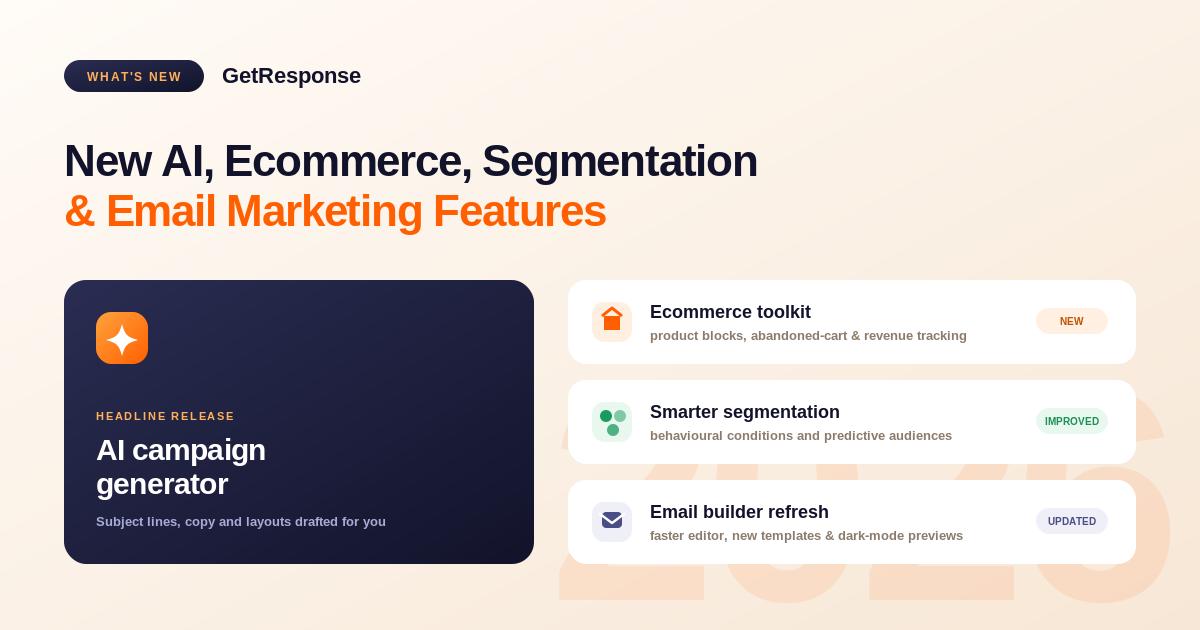
GetResponse has continued expanding its marketing platform throughout 2026 with new features focused on AI, ecommerce automation, customer segmentation, email performance, and personalization.
Recent updates include AI-powered performance insights, ready-made ecommerce segments, product recommendations based on shopper behavior, revenue attribution, improved tracking controls, and new tools for ecommerce campaigns.
These changes make GetResponse increasingly useful for businesses that want to combine email marketing with automated customer journeys and ecommerce campaigns.
AI Insights Can Now Be Exported as PDF
One of the recent updates allows users to export AI Insights to PDF.
GetResponse’s AI-powered insights analyze campaign performance and can now be saved as a PDF for review or sharing. This can make it easier for marketing teams to discuss campaign performance without requiring everyone to access the GetResponse dashboard.
New Ecommerce Segments
GetResponse introduced ready-made ecommerce segments to make audience targeting easier.
These include segments for use cases such as:
Abandoned carts
Repeat buyers
First-time buyers
Other shopper behaviors
Instead of building every audience segment manually, marketers can select predefined segments and use them in newsletters or automation workflows.
Product Recommendations Based on Shopper Behavior
In August 2026, GetResponse introduced a new content block that can show shoppers products they previously viewed but did not purchase.
The block can be added to newsletters and automation messages such as:
Cart recovery
Post-purchase campaigns
Win-back campaigns
Marketers can also customize the number of products, columns, and visual styling.
This gives businesses a way to personalize emails using actual browsing behavior.
New Open-Tracking Controls
GetResponse also introduced controls that allow users to disable open tracking for individual messages.
The feature is particularly relevant to users sending emails to subscribers in France and Italy, following regulatory guidance concerning email tracking pixels. Click tracking continues to work when open tracking is disabled.
This gives marketers more control over how email engagement is measured.
Revenue Attribution for Email Campaigns
Another important 2026 update is revenue attribution.
GetResponse now allows businesses to connect purchases with the emails that helped generate them.
Marketers can see attributed revenue at different levels, including:
Individual messages
Automation workflows
Ecommerce campaigns
Average order value
Orders generated
This helps businesses move beyond simply measuring opens and clicks and understand the actual revenue impact of their email marketing.
Shopify Customer Tags Sync With GetResponse
GetResponse added Shopify customer-tag synchronization for paid plans.
This allows Shopify tags such as:
VIP customers
Repeat buyers
Lapsed customers
to be synchronized with GetResponse.
Marketers can then use this information for segmentation, personalization, and automation.
Price Drop Campaigns
GetResponse introduced Price Drop Campaigns to help ecommerce businesses reconnect with shoppers when products become cheaper.
The campaign can automatically notify interested shoppers when the price of a product they showed interest in drops.
This can be useful for recovering customers who were interested in a product but decided not to purchase at the original price.
Product Recommendations Inside Chats
GetResponse also added product recommendations to its Chats functionality.
Businesses can connect their store and recommend products directly inside customer conversations, allowing shoppers to discover products without leaving the chat experience.
This connects customer support and ecommerce selling more closely.
New Email Creator
GetResponse also introduced a redesigned Email Creator.
The updated creator was designed to make email creation faster and easier, with improvements to the overall editing experience and responsive email design. GetResponse says the new creator is available for newsletters, autoresponders, and marketing automation messages.
AI Email Creation
GetResponse continues to expand its AI-powered email creation tools.
The AI Email Generator can help marketers create:
Email copy
Subject lines
Email layouts
Marketing messages
The AI tools are integrated into the email creation workflow, allowing users to generate or modify content without leaving the editor.
AI-Powered Segmentation
GetResponse has also introduced AI-assisted segmentation.
Instead of manually creating complex conditions, marketers can describe the audience they want to target, and AI can help determine the appropriate segmentation conditions.
This can make audience targeting easier for users who are new to advanced segmentation.
Why These Updates Matter
The latest GetResponse updates show a clear focus on making marketing campaigns more:
Personalized → Automated → Measurable
Businesses can now use shopper behavior to personalize messages, use automation to reach customers at the right moment, and use revenue attribution to understand which campaigns contribute to sales.
This moves email marketing beyond simply sending newsletters.
What Businesses Can Do With the New Features
Ecommerce Brands
Use product recommendations, price-drop campaigns, Shopify tags, and ecommerce segments to create more personalized customer journeys.
Marketing Teams
Use AI Insights and revenue attribution to understand campaign performance.
Small Businesses
Use pre-built segments and AI tools to simplify campaign creation.
Online Stores
Connect customer behavior with automated email campaigns to recover potential sales.
Frequently Asked Questions
What are the latest GetResponse updates in 2026?
Recent updates include AI Insights PDF export, ecommerce segments, personalized product recommendations, revenue attribution, Shopify tag synchronization, price-drop campaigns, and improved email tracking controls.
Does GetResponse have AI features?
Yes. GetResponse provides AI tools for email creation, subject lines, campaign generation, segmentation, and performance insights.
Can GetResponse track email revenue?
Yes. Revenue attribution can connect email messages and automation workflows with attributed purchases and revenue.
Does GetResponse integrate with Shopify?
Yes. GetResponse supports Shopify-related ecommerce functionality, including customer-tag synchronization and ecommerce campaigns.
Can GetResponse recommend products?
Yes. GetResponse provides product recommendation features that can use shopper behavior to personalize products shown in emails and other experiences.
Final Verdict
GetResponse’s 2026 updates show that the platform is moving further toward AI-powered personalization, ecommerce automation, and revenue-focused email marketing.
The combination of AI Insights, product recommendations, pre-built segments, revenue attribution, Shopify synchronization, and price-drop campaigns gives marketers more ways to create targeted customer journeys and measure their business impact.
For businesses already using GetResponse, these updates can reduce manual marketing work while making campaigns more personalized and measurable.