How-to
How to Find and Connect With B2B Leads Using Apollo.io
Deals Stacks
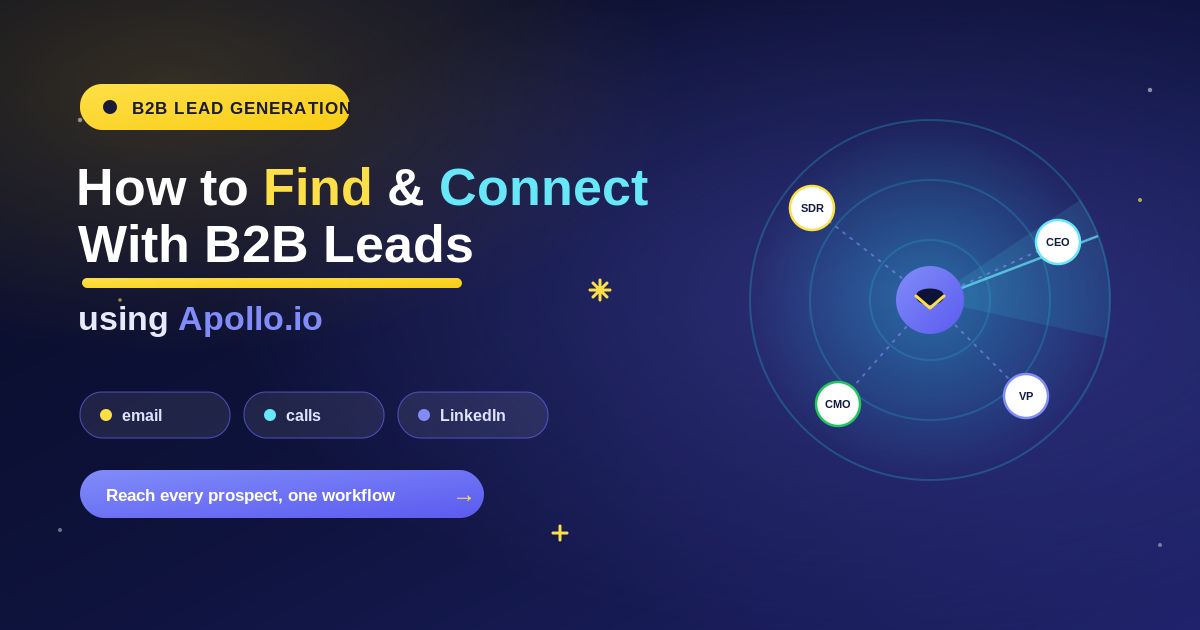
How to Find and Connect With B2B Leads Using Apollo.io
Finding more leads is not usually the biggest challenge in B2B sales. The real challenge is finding people who are actually relevant to what your business offers.
A large list of random contacts may look impressive, but it does not necessarily create more sales opportunities. Effective prospecting starts with identifying the right companies, finding the right decision-makers within those companies, and reaching out with a message that makes sense for them.
Apollo.io can help with this process.
The platform combines B2B contact and company data with prospecting filters, list building, sales intelligence, sequences, enrichment, and outreach capabilities.
In this how-to guide, we’ll focus on one clear goal: how to use Apollo.io to find relevant B2B leads and turn them into a structured outreach list.
Step 1: Define the Type of Lead You Want
Before opening Apollo and searching for contacts, define your ideal lead.
This is one of the most important steps.
If you search without clear criteria, you may end up with thousands of contacts but very few genuinely useful prospects.
Start by defining your Ideal Customer Profile, or ICP.
Your ICP describes the type of company most likely to need and benefit from your product or service.
Consider factors such as:
Industry: Which industries are most relevant?
Company size: Do you target startups, small businesses, mid-market companies, or enterprises?
Location: Which countries or regions can you serve?
Business type: B2B, B2C, SaaS, e-commerce, agencies, or another segment?
Business problem: What problem does your product solve?
Once you know the type of company, identify the people you need to reach within those organizations.
Step 2: Identify the Right Decision-Makers
A good company can still produce a bad lead if you contact the wrong person.
Imagine you sell recruitment software.
A company may perfectly match your ideal customer profile, but contacting someone in graphic design or accounting probably will not help.
You would more likely want to identify people such as:
HR Directors, Heads of Talent Acquisition, Recruitment Managers, People Operations leaders, or other relevant HR decision-makers.
The right title depends on your product and the size of the company.
At a small startup, a founder may make purchasing decisions.
At a larger organization, a department head, director, manager, procurement team, or multiple stakeholders may be involved.
Before searching, answer one question:
Who is most likely to understand and care about the problem my product solves?
That person should become the focus of your prospecting.
Step 3: Open Apollo’s Prospect Search
Once your target audience is clear, open Apollo.io’s prospecting or people-search functionality.
Apollo provides access to a large B2B contact and company database that can be searched using multiple criteria.
A broad search can produce a large number of results.
Do not be concerned if the initial number is huge.
The purpose of the next steps is to narrow that broad market into a focused group of relevant prospects.
Think of it as moving from:
Everyone who could possibly be a customer
to:
The people most likely to be worth contacting right now.
Step 4: Filter Leads by Job Title
Start narrowing your results based on relevant job titles.
Suppose you sell an email marketing platform.
Potential titles might include:
Head of Marketing.
Marketing Director.
Email Marketing Manager.
Growth Lead.
Chief Marketing Officer.
However, do not simply add every marketing-related title you can think of.
Consider who actually influences the decision to purchase your type of product.
A large enterprise and a 20-person startup may have completely different decision-making structures.
Your job-title filters should reflect your actual target market.
Step 5: Use Seniority Carefully
Seniority can help you narrow prospects, but higher seniority does not always mean a better lead.
For example, contacting the CEO of a company with 20 employees may make sense.
Contacting the CEO of a company with 50,000 employees about a specialized team-level software product may not.
In that case, a director or manager in the relevant department could be a much better contact.
Think about decision-making relevance, not just seniority.
Ask:
Does this person experience the problem?
Can they influence a buying decision?
Would they realistically evaluate a product like ours?
This produces better targeting.
Step 6: Filter by Industry
Industry filtering can remove a large number of irrelevant prospects.
Suppose your product is specifically designed for e-commerce businesses.
Contacting companies in completely unrelated industries would waste both your time and theirs.
Use relevant industry criteria to narrow your audience.
However, avoid making your filters unnecessarily restrictive.
Sometimes a product works across several related industries.
Start with your strongest customer segments and expand gradually based on results.
Step 7: Filter by Company Size
Company size can significantly affect whether a prospect is a good fit.
A product designed for enterprise organizations may be too expensive or complex for a five-person business.
A lightweight tool built for small businesses may not meet the security and operational requirements of a global enterprise.
Use available company-size or employee-range criteria to focus on organizations that realistically match your offering.
For example, if your strongest customers typically have between 50 and 500 employees, that can be a useful starting point.
Your actual criteria should be based on your business, not a generic recommendation.
Step 8: Filter by Location
Location can be important for several reasons.
Your company may only serve certain countries.
Your sales team may work specific territories.
Your product may have language or regulatory limitations.
Your pricing may only make sense in certain markets.
Use location filters where they genuinely improve targeting.
Do not target the entire world simply because the database allows it.
A focused geographic strategy is often easier to test and optimize.
Step 9: Add More Relevant Filters
Depending on your Apollo plan and available data, additional filters may help you narrow prospects further.
These can include different company, people, technology, or other sales-intelligence criteria.
Use these filters strategically.
For example, if your product integrates with a particular technology, knowing which companies use that technology may make your prospecting more relevant.
But do not add filters just because they are available.
Every filter should have a clear purpose.
Ask:
Does this criterion make the prospect more likely to need our product?
If the answer is no, you may not need it.
Step 10: Review Your Search Results
Once you have applied your main filters, review the results.
Do not immediately save every contact.
Look at a sample first.
Check the companies.
Review job titles.
Ask whether these are genuinely the people you intended to find.
For example, suppose you wanted HR decision-makers at mid-sized SaaS companies.
If your results mostly contain junior recruiters at unrelated businesses, your filters need improvement.
Adjust the search until the results closely match your ideal customer profile.
This review step can save significant time later.
Step 11: Create a Focused Lead List
Once your search produces relevant prospects, save appropriate contacts into a clearly organized list.
Avoid vague names such as:
New List 1
or
Leads
Instead, use a descriptive name.
For example:
US SaaS HR Leaders – July
or
Mid-Market E-commerce Marketing Directors
A clear naming system becomes increasingly important as you create more campaigns.
You should be able to look at a list name and immediately understand who is inside it.
Step 12: Segment Your Leads
Do not put every prospect into the same outreach campaign.
Different groups may have different problems and priorities.
Imagine you sell project management software.
You may target:
Marketing agencies.
Software companies.
Consulting firms.
Professional services businesses.
All of them might use your product, but the reason they need it could be different.
Segmenting prospects allows you to create more relevant messaging.
A marketing agency may care about managing client projects.
A software company may care about coordinating product teams.
Same product.
Different context.
Step 13: Work With Contact Information Carefully
Once you have identified relevant prospects, Apollo may provide access to available professional contact information depending on data availability, your account, and credit usage.
Do not reveal or export contact data without first checking whether the prospect is genuinely relevant.
A better process is:
Search → filter → review → shortlist → access relevant contact data.
This helps you use your available resources more efficiently.
Professional contact data can also change.
People move between companies.
Roles change.
Email addresses and phone numbers may become outdated.
For important prospects, review the information before relying on it.
Step 14: Prioritize Your Best Leads
Not every prospect deserves the same amount of attention.
Create a simple prioritization system.
For example:
High priority: Strong company fit + right decision-maker + clear need.
Medium priority: Good fit but less obvious timing or decision-making authority.
Low priority: Possible fit but requires more research.
This helps sales representatives spend more time on opportunities with stronger potential.
Apollo’s available signals, scoring, research, and data can support prioritization, but human judgment remains important.
A database can tell you that someone matches your filters.
It cannot fully understand every business relationship or buying situation.
Step 15: Research Before You Reach Out
This is where many prospecting workflows go wrong.
A salesperson finds an email address and immediately sends a template.
Instead, research the prospect.
Understand:
What does the company do?
What is the person’s role?
What business problem might they have?
Why is your product relevant?
Is there a genuine reason to contact them now?
You do not need to spend an hour researching every prospect.
The depth of research should reflect the potential value of the opportunity.
For a high-value enterprise account, deeper research may be worthwhile.
For a broader SMB campaign, segment-level personalization may be more practical.
Step 16: Write a Relevant First Message
Your first outreach message should be clear and easy to understand.
Avoid generic introductions such as:
“We are a leading innovative company providing cutting-edge solutions.”
That does not tell the prospect why they should care.
A better message focuses on them.
A simple structure is:
Reason for reaching out
Explain why this person or company is relevant.
Problem
Mention a business challenge connected to their role.
Value
Explain briefly how you may help.
Next step
Ask for one simple action.
For example:
Hi Alex,
I noticed you lead sales operations at a growing B2B software company. We help sales teams reduce the manual work involved in prospect research and lead management.
Would it be useful if I shared a quick example of how the workflow works?
Keep it natural.
Your real message should reflect your actual product and research.
Step 17: Personalize Without Sounding Artificial
Personalization is important, but bad personalization can be worse than none.
Avoid meaningless compliments such as:
“I absolutely love the amazing work your incredible company is doing.”
Unless you genuinely have something specific to say, it sounds automated.
Useful personalization is based on relevant context.
You might reference:
The person’s role.
A relevant company development.
A business challenge.
A technology they use.
A meaningful trigger.
A specific reason your solution fits.
The purpose is not to prove that you researched the prospect.
The purpose is to make your message relevant.
Step 18: Add Qualified Leads to a Sequence
Apollo’s sequence functionality can help organize outreach and follow-ups.
Once you have a qualified list, you can create an appropriate sequence rather than manually remembering every contact.
Keep your first sequence simple.
For example, it might contain an initial outreach step followed by a small number of thoughtful follow-ups.
The exact structure depends on your audience, sales cycle, communication channel, and applicable requirements.
Do not build a long sequence simply because automation makes it possible.
Every step should have a reason.
Step 19: Make Follow-Ups Useful
A follow-up should add something.
Avoid repeatedly writing:
“Just following up on my previous email.”
Instead, add context.
You could:
Clarify the value proposition.
Share a relevant example.
Provide a useful resource.
Address a common concern.
Ask a simpler question.
Your follow-up should make the conversation easier, not create pressure.
If someone asks not to be contacted, respect that preference.
Step 20: Use Automation Without Losing Relevance
Apollo can help automate parts of the sales workflow.
Automation is useful for repetitive activities.
However, it should not replace judgment.
Before automating a campaign for thousands of prospects, test it with a smaller group.
Check:
Are these actually the right people?
Does the message make sense?
Are people responding positively?
Are the replies relevant?
If the answer is no, scaling the campaign will not solve the problem.
Fix the targeting or message first.
Automate what works—not what is broken.
Step 21: Track Meaningful Results
Do not judge your lead-generation strategy only by how many contacts you find.
A list of 10,000 prospects is not automatically successful.
Track outcomes that matter.
For example:
Are you finding relevant decision-makers?
Are you receiving meaningful responses?
Are prospects interested in continuing the conversation?
Are conversations turning into meetings?
Are meetings becoming qualified opportunities?
Are opportunities generating revenue?
The purpose of B2B prospecting is not to build the biggest spreadsheet.
It is to create relevant business conversations.
Step 22: Improve Your Search Based on Results
Your first prospect search will rarely be perfect.
Use campaign results to improve your targeting.
Suppose HR Directors respond well but HR Managers rarely do.
That may suggest seniority needs adjustment.
Perhaps SaaS companies respond better than professional services businesses.
That may suggest stronger industry fit.
Perhaps companies with 100–500 employees convert better than very small businesses.
Use this information to refine your Apollo searches.
Over time, your prospecting should become more focused.
Example: Finding B2B SaaS Leads With Apollo.io
Imagine you sell an HR automation platform.
Your ideal customers are growing B2B SaaS companies.
A simplified workflow could look like this:
First, define the target company profile.
For example, focus on relevant SaaS businesses within your preferred market and company-size range.
Next, identify the likely decision-makers.
These might include HR Directors, Heads of People, Talent leaders, or other relevant roles.
Apply your criteria in Apollo.
Review the results manually.
Remove obviously irrelevant prospects.
Save qualified leads into a clearly named list.
Work with the available contact data for the prospects you actually need.
Research the companies.
Segment prospects where necessary.
Write relevant outreach based on the problems your HR automation platform solves.
Add appropriate prospects to a structured sequence.
Then track responses and use the results to improve your next search.
The process is simple in principle:
Target → Find → Filter → Review → Research → Connect → Learn.
Common Mistakes to Avoid
Targeting everyone: A broad audience usually creates generic outreach.
Choosing the wrong decision-makers: Company fit alone is not enough.
Saving every search result: Review prospects before building your list.
Using too much contact data too quickly: Prioritize relevance before consuming credits or exporting data.
Skipping research: Contact information does not tell you why someone should care.
Using fake personalization: Meaningless compliments do not create relevance.
Over-automating: Test your process before scaling it.
Ignoring opt-outs and restrictions: Use professional contact data responsibly and follow applicable communication requirements.
Measuring only lead volume: Focus on qualified conversations and business outcomes.
Frequently Asked Questions
How do I find B2B leads using Apollo.io?
Define your ideal customer profile, use Apollo’s people and company search tools, apply relevant filters, review the results, and save qualified prospects into focused lists.
Can I search by job title in Apollo.io?
Apollo provides prospecting filters that can help users narrow contacts based on professional and company criteria, including role-related information. Exact filters can vary by current product and plan.
Can I find decision-makers with Apollo.io?
Yes. By combining company criteria with job role, seniority, and other relevant filters, you can narrow your search toward people who are more likely to influence purchasing decisions.
Can Apollo.io provide contact information?
Apollo provides professional B2B contact and company data. Data availability, access, and credit usage depend on the record and current plan.
Can I contact leads directly through Apollo.io?
Apollo provides sales engagement and sequence capabilities that allow supported outreach workflows to be managed within the platform.
Should I add every Apollo lead to an automated sequence?
No. Review and qualify prospects first. A smaller, relevant list generally creates a stronger foundation for outreach than sending automated messages to every available contact.
Conclusion
Using Apollo.io effectively is not about finding the largest possible number of B2B leads.
It is about finding the right companies and the right people within those companies.
Start with a clearly defined ideal customer profile.
Use Apollo’s prospecting filters to narrow your audience based on meaningful criteria such as company characteristics, industry, location, job role, and seniority.
Review your results before saving contacts.
Organize qualified prospects into focused lists and prioritize the strongest opportunities.
Then research your prospects before reaching out.
Use relevant, human communication instead of generic sales templates, and use Apollo’s sequences and automation to support a process that already works.
The most effective workflow is:
Define → Search → Filter → Qualify → Research → Connect → Measure → Improve.
Apollo.io can make B2B prospecting faster and more organized, but the quality of your results still depends on the decisions behind the technology.
When good data, careful targeting, relevant messaging, and thoughtful automation work together, Apollo.io can help turn prospecting from a volume-based activity into a more focused process for creating meaningful sales opportunities.